
Window Wall and Curtain Wall Systems
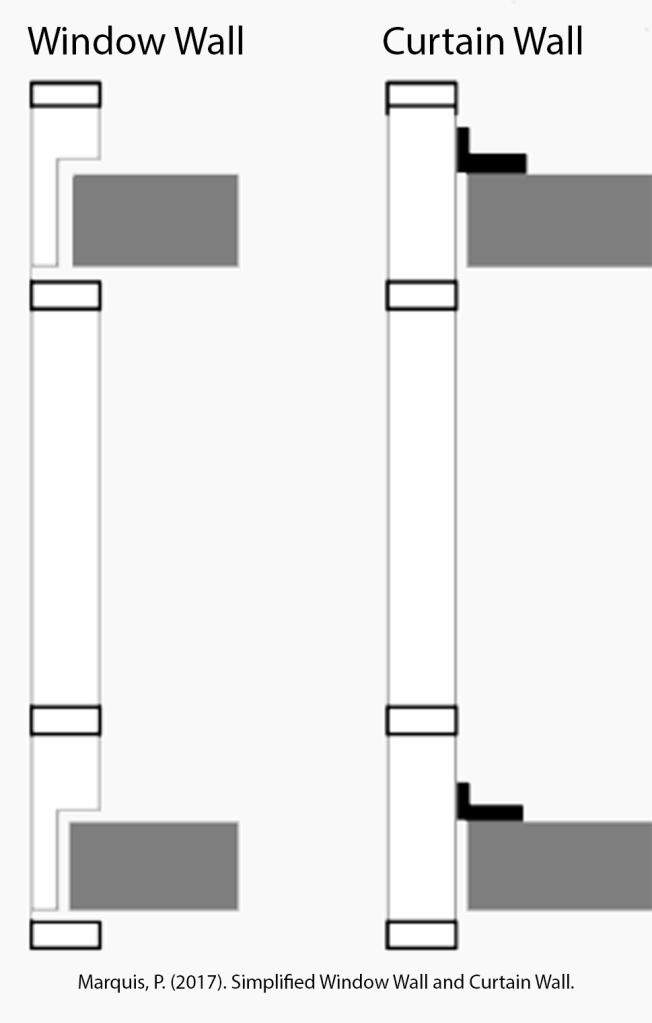
The two main glass cladding systems in Canada are the window wall and curtain wall. The defining
difference between the systems is that the window wall structurally sits between the slabs and the curtain
wall is hung off the slab edges. The window wall is used in residential construction as it allows a cost-efficient way to compartmentalize the units and allows units with operable windows and balconies. Overall,
curtain walls perform superior to window walls. However, many improvements in
new window wall designs allow them to outperform a typical curtain wall while still being less expensive. Curtain
walls are more expensive, take longer to install, and require specialized crew and equipment to install.
Window walls can also take away some useable floor space and can be aesthetically less appealing, which
can cause commercial constructors to prefer the curtain wall. The performance of both systems relies heavily on
appropriate design and installation.

- The window wall is an aluminum framed unitized cladding system used primarily on mid and high-rise residential construction
- The distinctive feature of the window wall is that it spans between the floor slabs
- At the base of each floor, the window wall units are fastened laterally to an aluminum angle, which, in turn, is secured to the floor slab.
- The floor slab directly supports the vertical load of the unit. The top of the unit is affixed with aluminum straps on the underside of the slab overhead.
- The window wall panels are typically installed from the building interior, which improves logistics and simplifies installation and costs.
- The majority of the panels in a window wall system are vision glazing, although, at locations such as shear walls and column covers, opaque panels are installed.
- The system is prefabricated in a factory and installed on-site similar to the unitized curtain wall system.

- The window wall requires substantially less infrastructure to facilitate installation.
- Since the curtain wall completely bypasses the slab edge, fire stopping and extra finishing are typically needed, as opposed to the window wall.
- Window walls are very customizable and can easily incorporate operable windows, balcony doors, and other desired penetrations compared to the curtain wall.
- The window wall also compartmentalizes the units better than a curtain wall since there is no gap between the slab edge and the cladding.
- Compartmentalization has become desired to reduce the stack effect and improve energy efficiency.
- Window walls are installed between floors in contrast to the continuous curtain walls, causing sound, smoke, and odour transmission between floors to decrease, which is desirable for multi-unit residential buildings.
 Arc Building Envelope Design Inc.